
Contents
- My exercise data for 2025
- Why only what gets measured keeps going
- My workouts are actually very ordinary
- The key isn't willpower — it's visual tracking
- A famous story from Atomic Habits says the same thing
- Why visual tracking really works
- What I did is exactly the same as that story
- Another key idea from The 12 Week Year
- If you want to build an exercise habit too
- Conclusion
Most people know exercise is important.
The hard part has never been knowing it; it's keeping it up.
Most people can't exercise for the long haul not because they don't try hard enough, but because exercise relies too much on willpower. Get busy, get tired, miss a few days, and it's hard to get back on track.
In this article I want to share a method I practiced for a whole year.
Not fired-up enthusiasm, not a test of self-discipline, but a simple, stable system that made exercise a natural part of my life.
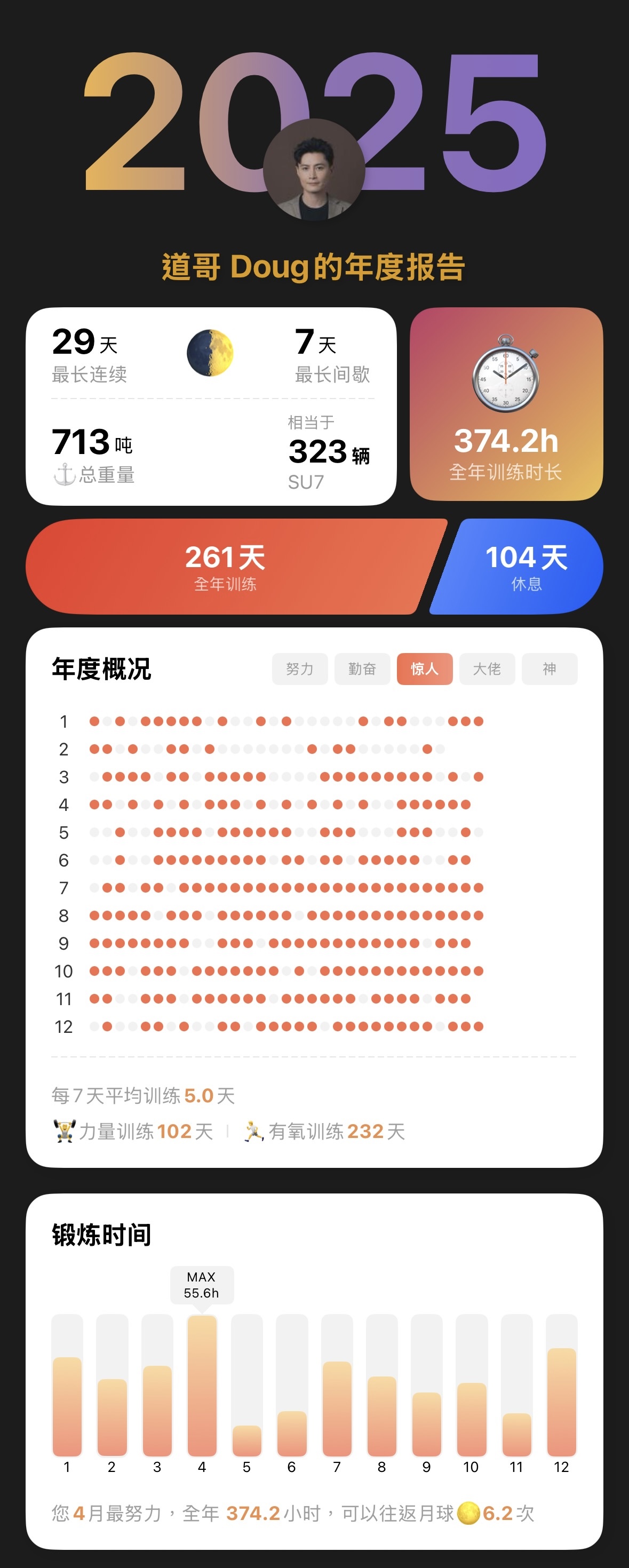
My exercise data for 2025
Let's start with the data, because data doesn't lie.
Out of the 365 days of 2025:
- I exercised on 261 days — about 71%
- My longest unbroken streak was 29 days
- I averaged 5 days of exercise a week
- Total exercise time for the year: 374.2 hours
- Total weight lifted for the year: 713 tonnes
Looking back at these numbers, even I was surprised.
Not because the training was especially hard, but because I really did keep exercising for an entire year.
Why only what gets measured keeps going
Peter Drucker, the father of modern management, is often credited with a classic line:
If you can't measure it, you can't manage it.
It fits exercise habits perfectly.
Without records, you can't measure.
Without measuring, you can't adjust.
Without adjusting, you usually end up giving up.
Many people aren't lazy; their effort just leaves no trace they can look back on.
My workouts are actually very ordinary
The short version: I didn't do any extreme training.
My exercise is very everyday:
- about 20 minutes of yoga a day
- strength training three to four times a week, about an hour each
- sometimes a 10- to 30-minute walk after dinner
No sweat-drenched challenges, no high-intensity programs.
The real difference came down to one thing.
The key isn't willpower — it's visual tracking
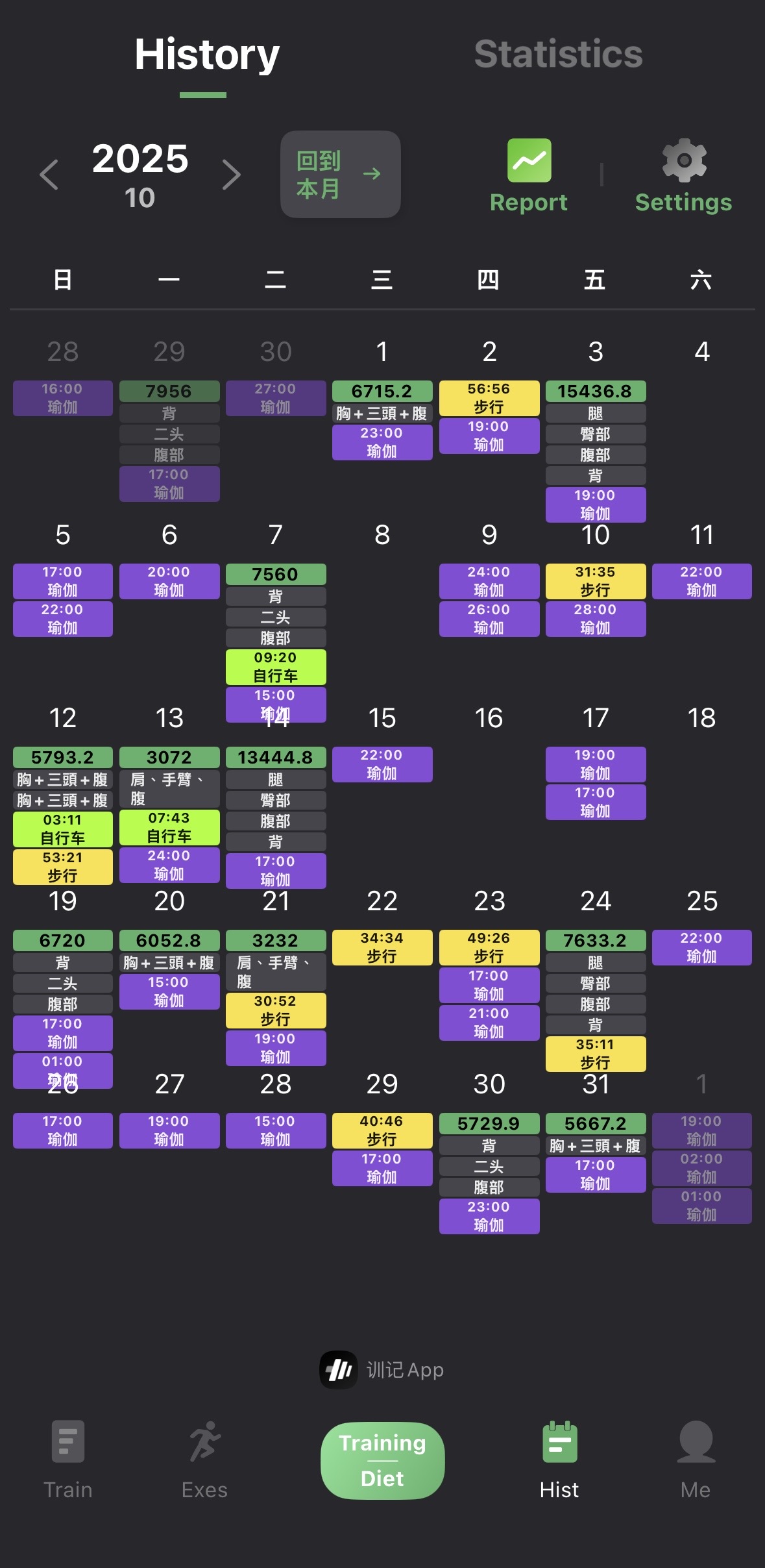
I record every workout in one place.
Each time I open the log, I look at only two things:
- did I exercise today?
- which days did I miss?
Tracking like this keeps your behavior very honest.
I use the Xunji workout app with an Apple Watch, but the tool was never the point. What matters is that the record does two things:
- you understand it at a glance
- it leaves no room for ambiguity
A famous story from Atomic Habits says the same thing
Atomic Habits tells a well-known story.
Jerry Seinfeld is a famous Hollywood comedian.
A young comedian once asked him:
“How do you keep writing good jokes?”
Seinfeld's answer was simple. He hung a big wall calendar for the whole year.
Every day he wrote — good or bad — he drew a big red X over that day.
Day one, one X. Day two, two Xs. By day three, a line starts to appear.
After a while, the calendar fills with red chains.
And his only goal each day was:
“Don't break the chain.”
Why visual tracking really works
The reasons it works aren't complicated.
First, it turns abstract effort into concrete evidence.
You no longer need to feel like you're working hard; you know exactly which days you did it and which you didn't.
Second, it moves the measure of success from results back to the behavior itself.
You stop asking whether today's workout was effective and ask only whether you logged it.
Third, a streak creates psychological resistance to stopping.
Once you've logged several days in a row, breaking the chain feels like a waste.
What I did is exactly the same as that story
I just replaced the red X with my workout log.
That's the real message of Atomic Habits:
Success doesn't come from getting it right once, but from not giving up over a long time.
Every action you take is a vote for who you are.
Because I see myself as someone who values health, I do a little something every day that fits that identity.
Another key idea from The 12 Week Year
The 12 Week Year points out:
- results are lagging indicators
- daily execution is the leading indicator
This explains why most people fail at exercise.
We care about results too early, and overlook whether we actually did what we needed to do each day.
Looking back at 2025, I didn't do any particularly impressive workouts.
I simply put my attention on “did I do it today,” not on “will I see results right away.”
If you want to build an exercise habit too
Here's a practical suggestion:
- don't start by chasing the perfect workout plan
- first aim to have a record every day
- once the record is clear and visible, the habit starts running on its own
You don't need to try harder; you just need to make your effort visible.
Conclusion
Most people think an exercise habit comes from self-discipline, willpower or determination.
But what makes a behavior last has never been how long you can grit your teeth — it's how you see yourself.
When you stop asking “should I do it today?” and simply know “I'm the kind of person who does this,”
the choice no longer takes any effort.
This year, I didn't keep exercising by forcing myself.
I just slowly turned a behavior into a confirmation of who I am.
If you're stuck and can't keep going, stop asking yourself whether you're disciplined enough.
Ask yourself a different question:
Who do you want to become?