Contents
- What is the Golden Circle?
- Are you selling, or attracting?
- Why do I run FIRE University?
- A lesson from history: the Wright brothers vs. Langley
- Achievement and success are not the same
- How systems express a why: the Bridgeport Financial story
- When companies lose their soul: Starbucks and Walmart
- Only one competitor: who you were yesterday
- Conclusion: your why is what keeps you going for the long run
I recently finished a book that moved me deeply — one of those books I wish I'd read years ago: Simon Sinek's classic Start with Why. It isn't only about leadership; it's about what drives us in life. I'd often heard his “Golden Circle” idea and watched his talk, but only after reading the whole book carefully did I see how practical it is. It gave me a whole new understanding of why I run FIRE University.
In this post I want to share what moved me, and I hope my words help you find your own “why.”
What is the Golden Circle?
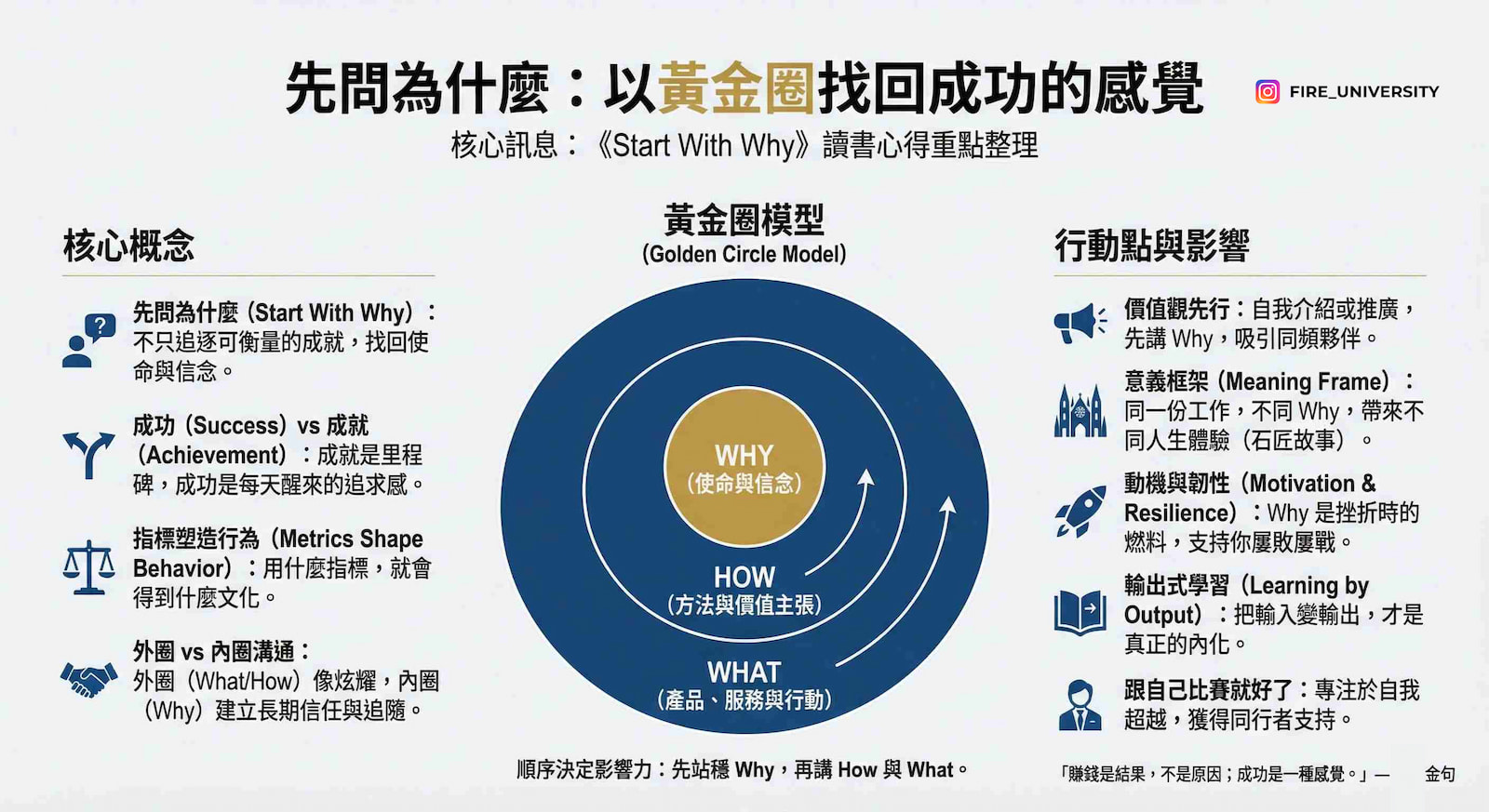
The core idea of the book is the Golden Circle. Picture three concentric circles: at the center is Why, the middle ring is How, and the outer ring is What.
Most people think, communicate and act from the outside in. We know exactly “what” we do and roughly “how” we do it, but very few people can say precisely “why” they do it.
Remember: the “why” here is never “to make money.” Money is a result, not a reason. Your real “why” is your purpose, your belief — what gets you out of bed each morning, and the core reason others should support you.
Are you selling, or attracting?
The book has a great example: doing business is like going on a date. Imagine a man on a first date who keeps bragging: “I'm rich, I have a mansion and fancy cars, I know lots of famous people, I'm often on TV, I'm good-looking, and I'm very pleased with what I've achieved.” Would he get a second date? Everything he said may be true, but he only talked about “what” and “how,” and there's no connection.
Now imagine he says instead: “What I'm most grateful for is that every day I get to do what I love — helping people unlock their potential. To live out that belief I've tried many things, and I've been lucky enough to make money, buy a home and a car, and even share my ideas on TV. I feel really fortunate.” Same facts — but by starting with “why,” she feels his values. That kind of attraction, starting from the core, is what builds lasting relationships.
Why do I run FIRE University?
When I reached this part, I stopped and thought for a long time. Friends often ask me, “Doug, why do you spend so much time recording a podcast?” Here are the three whys behind my channel:
- To spread FIRE and help people escape the rat race:
I was poor as a child and thought money would make me happy; later I discovered money can't buy real happiness. When I found FIRE, I realized we don't have to be bound by money. I want to pass that on and help more people take back control of their lives. - Output is the best way to learn, and a record of growth: I firmly believe output drives progress. I'm not especially smart and I don't come from a prominent background, but I want to record how I went from being dealt a bad hand to living the life I want, so people can see it's possible.
- Begin with the end in mind, and leave a warm legacy: At my funeral, I hope people remember “Doug was kind to me, Doug helped me,” not “Doug was good at making money.” I don't care whether I can take money with me; I care about the virtues and influence I leave behind.
Once my purpose became this clear, I stopped feeling discouraged by ups and downs in traffic or income. I know I'm not doing it for the numbers; I'm doing it to live out my why.
A lesson from history: the Wright brothers vs. Langley
The book tells a powerful story. In the early 20th century, the person most expected to conquer flight wasn't the Wright brothers but a man named Samuel Pierpont Langley.
Langley had everything needed to succeed: a Harvard professorship, a huge US$50,000 government grant, connections to steel magnate Andrew Carnegie, and a dream team of top talent. The Wright brothers had none of that — no sponsors, no one on the team with a college degree, and only the thin income of their bicycle shop to keep the dream alive.
But we all know how it ended: the Wright brothers invented the airplane. Why? Because Langley was driven by fame and fortune, while the Wright brothers wanted to change the world. Langley wanted to be famous like Edison; the Wrights genuinely wanted to solve the problem of flight. In 1903, after the Wright brothers flew for 59 seconds, Langley immediately quit — because if he couldn't be first, it meant nothing to him.
The lesson: your motivation largely determines your results.
Achievement and success are not the same
This is another point that struck me deeply. The author once attended a gathering of very successful entrepreneurs. About 80% of them had reached their financial goals (achievement), yet about 80% didn't feel “successful.”
- Achievement: a tangible result — a measurable goal with an end point, like a net worth of NT$10 million.
- Success: a feeling. It's the process of pursuing your “why” every morning when you wake up.
If you chase only achievement and forget your why, you'll just feel empty. Achievements are milestones on the road to success.
How systems express a why: the Bridgeport Financial story
The book tells the story of Harbridge, who founded Bridgeport Financial. Most debt collectors are cold and harsh because their bonuses depend on how much money they recover. Harbridge didn't want that. She required her staff to build a friendly rapport with debtors within three minutes and understand their difficulties.
Even more radical, bonuses weren't based on money but on how many thank-you letters employees sent. The result? Bridgeport collected three times the industry average, and debtors even came back to do business with them after paying off their debts. Her intention was different: not to grab money, but to care about people and help them solve their financial problems.
When companies lose their soul: Starbucks and Walmart
When a company forgets its why, it loses its magic.
- Starbucks: after Howard Schultz stepped back, his successors switched from ceramic cups to paper to save money, undermining the idea of the “third place.” The brand declined until Schultz returned and rediscovered its original purpose.
- Walmart: Sam Walton founded it to serve ordinary blue-collar workers and give them good things at low prices. After he died, new leadership forgot that why, and the company culture changed.
Only one competitor: who you were yesterday
Finally, I want to share the story of Ben Comen, a runner with cerebral palsy. Ben's arms and legs didn't coordinate well and he often fell; a race others finished in 25 minutes took him 45. But remarkably, after everyone else crossed the line, they would turn back and run the last stretch with him.
Ben teaches us: “When you compete against others, no one helps you. When you compete against yourself, everyone helps you.” His goal in each race wasn't to beat anyone, but to beat who he was yesterday — to get up faster after falling than he did the day before. That's also why I run my channel: I'm racing against myself. If this week is better than last week, I've succeeded.
Conclusion: your why is what keeps you going for the long run
Start with Why isn't a book that tells you how to succeed. It's a book that helps you realign your direction.
When your why is clear, the how gradually takes shape, and the what is simply the natural result.
When your why is blurry, no amount of technique or effort can stop you from burning out.
This book isn't only about leadership; it's about living a life that inspires. When you find your original purpose, every difficulty becomes easier to face.
If you're feeling lost, tired or low on motivation, maybe it isn't that you're not trying hard enough. Maybe it's time to ask yourself: why did I start in the first place?
The core ideas in this article come 100% from my own reflections on the book. I recorded my thoughts aloud with PLAUD and worked with Gemini to write it up. Technology shortens the distance between thought and output, letting me share what reading gave me more fully and more quickly.
Further reading: Book Notes: The Almanack of Naval Ravikant
Want more on FIRE and personal growth? Listen to the show (in Mandarin):
- Spotify: lihi.cc/qU9cX
- Apple Podcasts: lihi.cc/2uLOw
- YouTube: lihi.cc/KXUWZ
Follow me
- Instagram: lihi.cc/TYDZZ
- Facebook: lihi.cc/X0syS