
Newsletter › #17
Efficiency Is the Enemy of Awareness | An App That Helped Me Quit Social Media
【What I've been up to】
Hi, Reader.
How was your week?
The air in Kaohsiung has been pretty bad lately.
Because of the northeast monsoon, air quality across the southwest has been poor.
On the air-quality monitoring site it's usually yellow or orange (good is green).
Waking up to a gray, hazy sky every day
seems to cast a gray film over my mood too.
So I'm looking for a city to move to in winter:
“good air,” not too far a drive from Kaohsiung —
ideally within two hours.
Last week I went to Hengchun to look at hotels.
But the winter wind there is way too strong —
it gave me a headache. 🥹
Looks like Taitung is the only option left. I'll find time to go and scout it.
I'm curious: is the air good where you live?
【Life notes and reflections】
Have you ever had this happen? You've only just sat down to eat,
and before you know it, the meal is gone —
every movement smooth and efficient, not a wasted motion.
I used to be like that. I'm right-handed;
my right hand is more agile and practiced,
so it's more efficient at everything.
But at the dinner table, that efficiency became a weakness.
Because I was so practiced, my brain would switch to autopilot while I ate.
And because I eat fast, my stomach was often full before I even felt full.
To break this “mindless eating,”
I made a slightly odd decision: I started practicing eating with my left hand.
Why is efficiency the enemy of awareness?
We tend to see efficiency as a sign of progress;
civilization is often built on efficiency and speed.
But when something becomes too efficient and too easy, the brain switches into “power-saving mode.”
Thinking, Fast and Slow describes two systems in the brain:
System 1: automatic and fast, no thinking required.
System 2: deliberate and slow, requiring close attention.
So when I eat with my right hand, my brain goes into System 1,
and an automatic, unconscious state takes over my eating.
Breaking autopilot with inconvenience
When I moved my chopsticks to my left hand,
it was clumsy and slow, poorly coordinated, even shaky.
At first eating was hard — food kept falling.
That sounds like a hassle, but it's exactly what interrupts System 1.
When an action becomes difficult, System 2 switches on.
I have to pay attention to the table, because if I don't,
my braised egg rolls onto the floor and the sauce spills.
This “inconvenience” creates a physical barrier
that cuts off unconscious, automatic habits.
In psychology, this lines up with “mindful eating.”
Why is inconvenience actually good for us?
A book on habits describes an interesting experiment:
researchers had people eating popcorn at the movies
switch to their non-dominant hand.
Compared with those who kept using their dominant hand,
the non-dominant-hand group ate less
and were more aware of what they ate.
The friction of the non-dominant hand interrupts the habit.
When we add a little inconvenience to our lives,
we're actually creating opportunities for mindfulness.
Slowing down to hear what my body is saying
Research also shows it takes about 20 minutes for the brain to receive the signal that you're full.
When I ate with my right hand,
I'd often overeat before that signal arrived.
Eating with my left hand slowed me down and brought some unexpected benefits.
- More awareness:
controlling the fine movements of my left hand
forces me to focus on the plate in front of me.
- Less bloating:
I used to eat so fast I'd feel bloated and uncomfortable afterwards.
Now I eat more slowly and food stays in my mouth longer,
so I chew more thoroughly, which helps digestion and eases the bloating.
- Better portion control:
with enough time for the feeling of fullness to reach my brain,
I know when to put my chopsticks down.
In short: add a little friction to your life
We live in an age obsessed with efficiency — we even try to optimize eating.
But I've found that slow is actually faster; faster isn't always better.
I'm not suggesting you give up your right hand starting today. I just want to share an idea:
sometimes we need to deliberately create a little friction to push back against a numb, automatic life.
Whether it's taking a different route home or switching hands at dinner like me,
these small changes remind us to be mindful and live in the present.
Next time you eat, why not try your non-dominant hand?
Or do you have a quirky little habit that keeps you focused?
I'd love to hear about it.
【From the blog】
Digital nomading in Kanazawa, Japan: how I fell in love with co-living
Do you long for a freer life? At the end of 2025 I joined an Urban Retreat in Kanazawa, Japan — not just a trip, but an experiment in taking back my choices. Getting lost at Kyoto Station, falling for co-living, and the loneliness behind the dream of digital nomading. What the rose-tinted bubble of a free life really costs, and a new way to define success.
This week's episode
#63 | Why can't we stop when we have enough? The Psychology of Money #4
Enough is the hardest financial skill. A former McKinsey chief who went to prison wanting more, why Buffett never moved house, social comparison, and the story of the five balls.
Read the full show notes in English › (the episode is in Mandarin Chinese)
🍎Apple Podcasts
🎧Spotify
🎦YouTube
【Things I like】(not sponsored — just recommendations)
An app that helps you quit social media
Do you ever go to reply to a message,
accidentally open social media, and half an hour is gone?
I used to, but now I've almost quit.
Last week my average daily social media use was: Instagram 7 minutes, Threads 29 seconds.
Yes, you read that right — that little.
Here's my screen time on February 1: 1 hour 17 minutes.
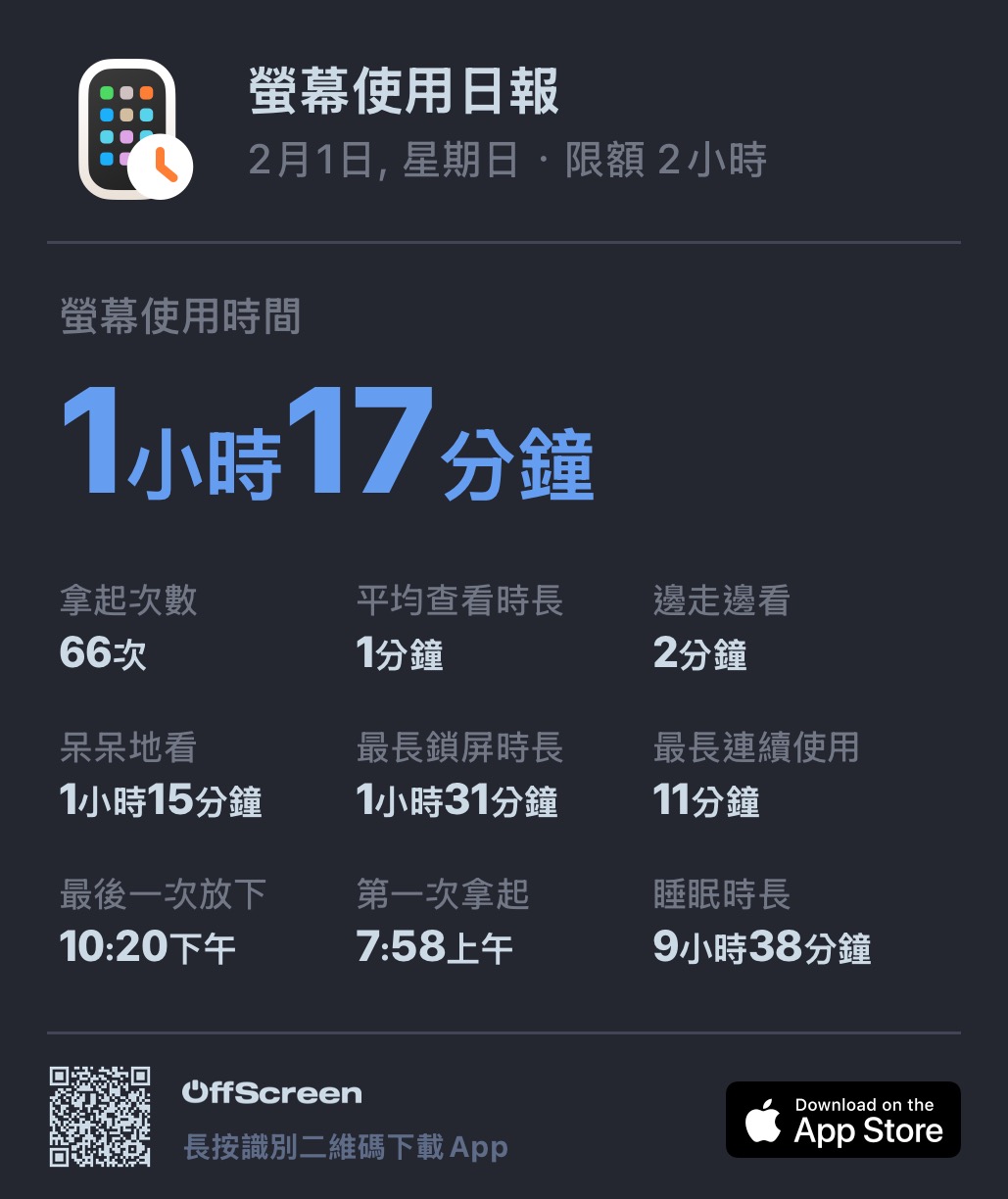
That's because I use an app called Offscreen.
It can limit how long you use certain apps,
and even which hours of the day you can use them.
I can use social media in two windows: 12 to 1 p.m. and 7 to 8 p.m.
If I try to use it outside those hours, the screen locks, like this.
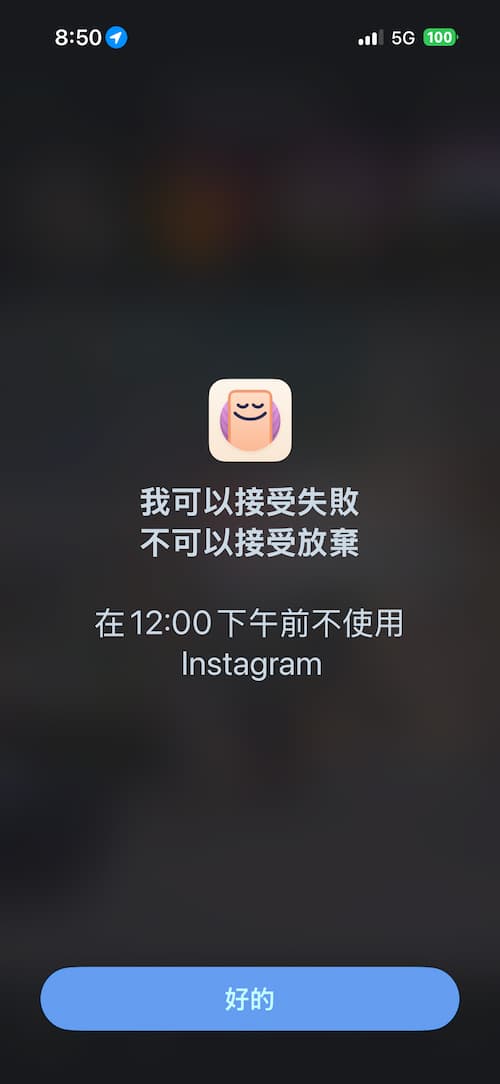
To use it outside those windows, I have to make a request —
say, three minutes to reply to a message — and then it locks again.
I get 50 minutes of requests a day, but I usually don't use them all.
As for the cost, I bought a lifetime membership — I think it was only a few hundred NT dollars.
Not expensive, and it has a Pomodoro timer too.
If you want to stop scrolling social media mindlessly, I highly recommend it.
If there's an app you find useful, let me know.
Group-buy deals
🎙️ New: PLAUD Note Pro AI note-taking recorder
🎧 Your own AI secretary
🎁 Enter 【FIRE95】 at checkout for 5% off
🛒 Buy: lihi.cc/up6Oq
——
⚡️ MONITORMATE MS-Z magnetic 3-in-1 charging stand
💼 The travel essential for Apple users — the smallest and lightest, with fast charging
🈹 Enter the code 【FIRE150】 for NT$150 off right away!
👉 monitormate.shop/MS_Fire
——
🎓 Don't Want to Go to Work Lab (an online course, in Mandarin)
👉 Course page: eleanorfilmacademy.tw/VlRMg
⚠️ Enter the code 【FIRETW】 at checkout for a special price of NT$4,200.
My sign-up link: eleanorfilmacademy.tw/NfK0d
That's it for this issue of the FIRE Life Weekly.
If you have any questions about the show or the newsletter,
just write to me at doug@firetw.com.
I look forward to hearing from you.
Have a lovely day,
and see you next time.
Doug